


Connect with us
contact@neuroflares.com

September 2, 2026
The promise of AI is no longer limited to answering questions or generating text. The frontier has shifted dramatically - businesses today want AI systems that can reason through multi-step problems, call external APIs, make decisions, and execute complex workflows without constant human hand-holding. This is the domain of agentic AI, and LangGraph is the framework that makes it production-ready.
At NeuroFlares, we build LangGraph-powered agents and multi-agent systems for businesses that need more than chatbots. In this guide, we break down what LangGraph is, why it matters, how it works, and how organisations can leverage it to automate real-world business processes at scale.
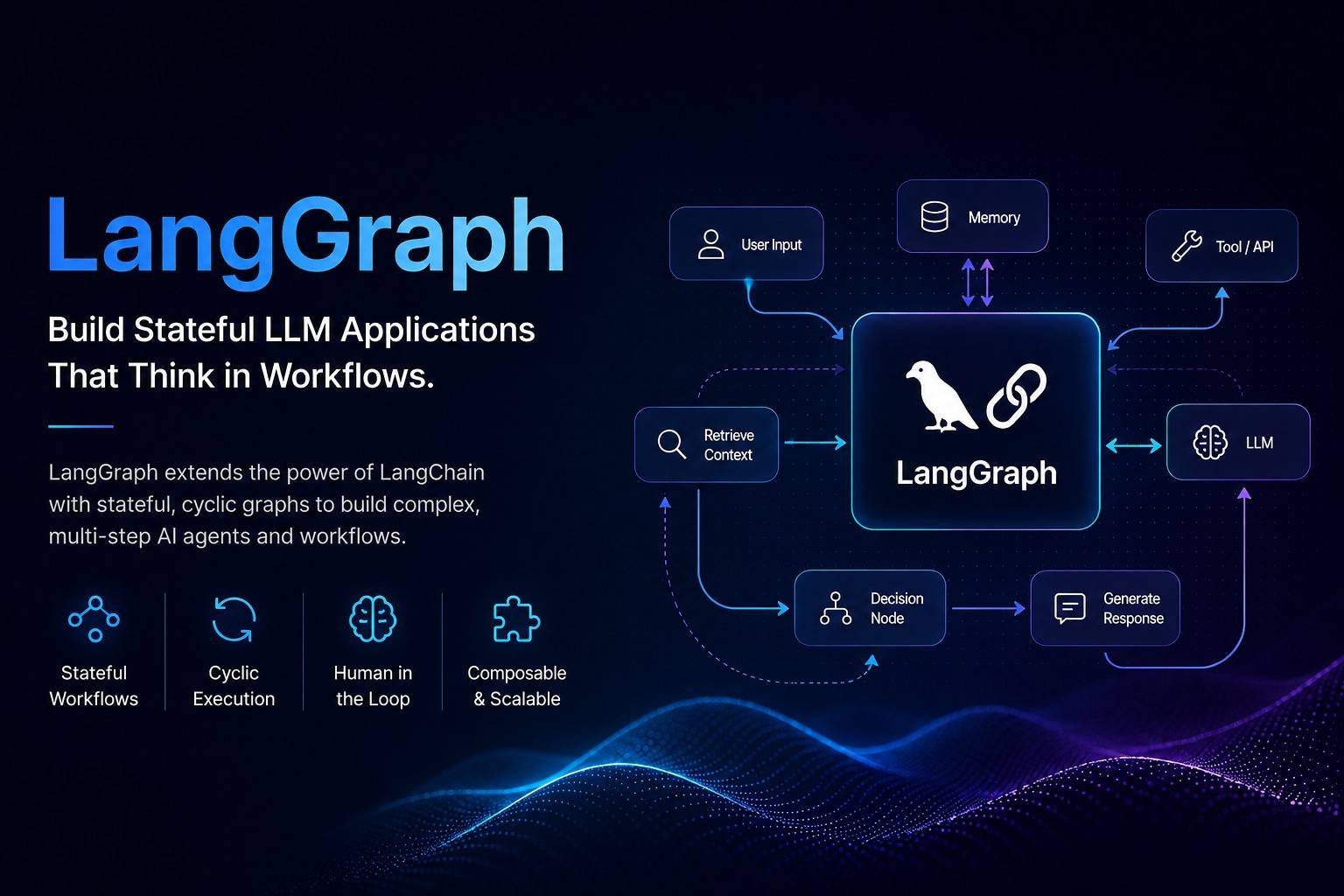
LangGraph is an open-source framework from the LangChain ecosystem designed to build stateful, multi-actor AI applications. While LangChain provides chains and tools for connecting LLMs with external data and APIs, LangGraph goes further - it allows developers to define AI workflows as graphs, where each node is an actor (an LLM, a tool, a human checkpoint) and each edge represents the flow of execution and state.
The key distinction is state management. Traditional LLM pipelines are stateless - each call starts fresh with no memory of previous steps. LangGraph introduces persistent state across an agent's entire lifecycle, enabling workflows that can pause, branch, loop, and even wait for human input before resuming.
Standard AI integrations - chatbots, Q&A systems, summarisation tools - solve narrow, well-defined problems. But most real business workflows are anything but narrow. Consider a customer support escalation: an agent must read a ticket, check the CRM for customer history, query a knowledge base, determine if escalation is needed, notify the right team, and update the ticket status. This is not a one-shot LLM call. It is a workflow with branches, decisions, tool calls, and state that evolves across steps.
Agentic AI built with LangGraph handles exactly these scenarios. By modelling the workflow as a graph with explicit state transitions, LangGraph agents can execute complex, multi-step processes autonomously while remaining observable, debuggable, and controllable.
LangGraph models multi-actor AI workflows as stateful, controllable graphs. Its architecture is built around five fundamental pillars:
Simple LLM API calls handle single-turn tasks with no memory. Sequential chains handle linear pipelines where each step feeds the next. LangGraph extends this to stateful, cyclic, and conditional workflows—graphs rather than chains—where agents can loop, branch, retry, and coordinate with other agents or humans.
Stateful, cyclic agents unlock sophisticated enterprise automation patterns that traditional linear pipelines cannot support:
At NeuroFlares, our LangGraph development process follows a structured approach that bridges business requirements and technical implementation:
LangGraph coordinates LLMs (OpenAI, Anthropic, Gemini, open-source models), tools (search, code execution, APIs), and memory systems (vector and relational stores). For teams deploying production AI, LangGraph provides the orchestration layer that turns raw model intelligence into reliable, enterprise-grade business software.
Getting started involves defining a typed state schema, writing functional nodes that return updated state, and linking them via StateGraph with conditional routing.
The shift from simple chatbots to stateful, multi-agent workflows is already transforming enterprise software. At NeuroFlares, we build custom LangGraph-powered systems tailored to automate complex workflows and augment your team’s capabilities. Contact our team to explore what agentic AI can do for your business.
Exploring this technology for your next project?
NeuroFlares specialises in building cutting-edge software solutions powered by the latest innovations. Let us turn your ideas into reality.
Let's work together.
2915 Ogletown Road, Newark, DE 19713, USA

213, G-Block, V.V.C.E, Gokulam, Mysore 570002, India
Connect with us
contact@neuroflares.com