


Connect with us
contact@neuroflares.com


April 10, 2026
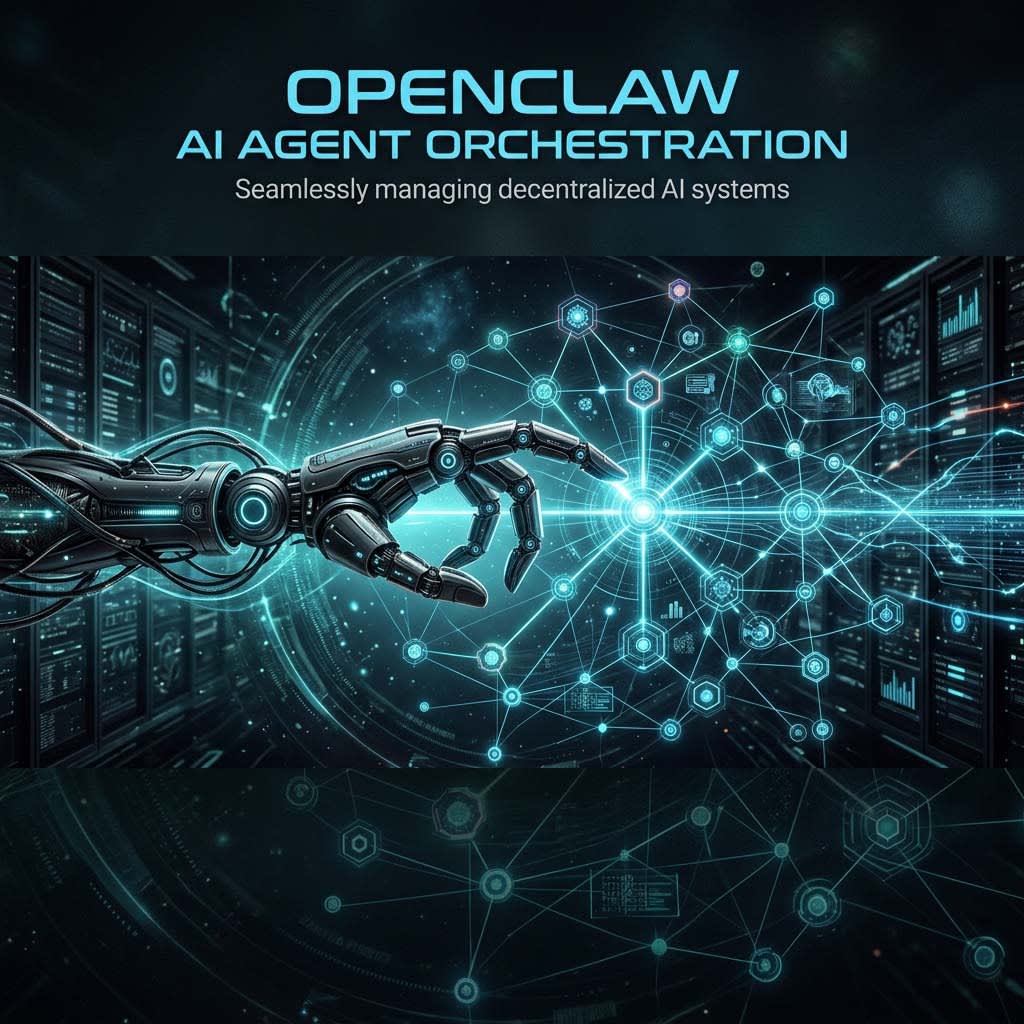
The landscape of AI agent frameworks is evolving at a breathtaking pace, and OpenClaw stands at the frontier of this transformation. Designed from the ground up for building, deploying, and orchestrating multi-agent AI systems, OpenClaw brings a level of control, transparency, and extensibility that sets it apart from conventional agent frameworks. Whether you are building autonomous research assistants, complex decision-making systems, or multi-step code generation agents, OpenClaw provides the architecture to make it possible.
OpenClaw is an open-source AI agent orchestration framework built for developers who need fine-grained control over how AI agents reason, plan, and act. Unlike higher-level abstractions that hide implementation details, OpenClaw exposes the full agent lifecycle-from initial prompt construction and tool selection to memory management and output validation. This transparency makes it ideal for production-grade deployments where reliability and debuggability are non-negotiable.
OpenClaw supports a wide range of underlying LLMs including GPT-4, Claude, Gemini, and open-source alternatives like LLaMA and Mistral. Its modular design allows teams to swap components independently-replacing the memory backend, switching the planning algorithm, or integrating custom tools-without rebuilding the entire agent stack.
At the heart of OpenClaw is a hierarchical agent orchestration model. A "Director" agent breaks down high-level goals into subtasks and delegates them to specialized "Worker" agents. Each Worker agent has access to a defined set of tools and operates within guardrails set by the Director. Results are aggregated, validated, and fed back into the planning loop until the goal is achieved or an exception is raised.
Compared to frameworks like LangChain Agents, AutoGen, or CrewAI, OpenClaw places an emphasis on explainability and production readiness. Where many frameworks optimize for rapid prototyping, OpenClaw optimizes for enterprise deployment. It includes built-in support for distributed execution, meaning individual agents can run on separate machines or containers, enabling horizontal scaling of complex agent pipelines.
The structured output enforcement is another standout feature. Every agent response is validated against a predefined schema before it is passed downstream, drastically reducing the unpredictability that plagues many LLM-based systems in production. This "contract-first" approach to agent communication makes OpenClaw pipelines far more predictable and auditable than their unstructured counterparts.
Deploying OpenClaw in a production environment requires thoughtful infrastructure planning. The framework provides Docker-based deployment templates and Kubernetes Helm charts out of the box. Observability is built in through OpenTelemetry integration, allowing teams to trace individual agent calls through their entire observability stack. This level of operational maturity is rare in the open-source agent ecosystem and is a primary reason why engineering teams are gravitating toward OpenClaw for serious workloads.
At NeuroFlares, we explore and deploy cutting-edge AI frameworks to build intelligent, autonomous systems for our clients. OpenClaw's Director-Worker model aligns perfectly with many of our client requirements-where complex, multi-step tasks need to be broken down, distributed across specialized agents, and reliably assembled into a final output. Running OpenClaw on our local AI infrastructure ensures that sensitive client data never leaves our secure environment, while still benefiting from the full power of state-of-the-art LLMs.
As AI models become more capable and agent architectures more sophisticated, the tools we use to orchestrate them become critically important. OpenClaw's commitment to transparency, extensibility, and production readiness positions it as a foundational framework for the next generation of autonomous AI systems. The convergence of powerful open-source LLMs and mature orchestration frameworks like OpenClaw means that building reliable, scalable, enterprise-grade AI agents is no longer the exclusive domain of large technology companies. It is now accessible to any organization with the vision to embrace it.
One of the most challenging aspects of building production AI agents is managing memory and context across multiple turns and agent calls. OpenClaw addresses this with a flexible memory abstraction layer that supports short-term conversational memory, long-term episodic memory stored in vector databases, and structured knowledge graphs for domain-specific reasoning. This allows agents to maintain coherent context over extended interactions-a critical requirement for complex, multi-session workflows.
OpenClaw's tool registry is one of its most powerful features. Agents can be equipped with any combination of tools-from web search and code execution to database queries and external API calls. The registry enforces schema validation on tool inputs and outputs, ensuring that agents cannot call tools with malformed arguments or misinterpret their responses. Custom tools can be registered in minutes by defining a name, description, input schema, and handler function, making it trivial to extend the framework for any domain-specific requirement.
For organizations deploying AI agents in sensitive environments, OpenClaw provides a comprehensive governance layer. Tool access can be restricted at the agent level-ensuring that a customer-facing agent cannot inadvertently access internal financial systems. All agent actions are logged with cryptographic timestamps, creating an immutable audit trail. Input and output filtering middleware can be configured to detect and block unsafe content, ensuring that agents operate within well-defined behavioral guardrails at all times.
One of the most forward-looking aspects of OpenClaw's design is its model-agnostic architecture. As the AI landscape continues to diversify-with specialized models for vision, code, reasoning, and multi-modal tasks-the ability to route different subtasks to the most capable model becomes a significant competitive advantage. OpenClaw's routing layer allows Director agents to dynamically select the most appropriate model for each Worker task, enabling hybrid pipelines that combine the strengths of multiple LLMs within a single, coherent workflow.
Exploring this technology for your next project?
NeuroFlares specialises in building cutting-edge software solutions powered by the latest innovations. Let us turn your ideas into reality.
Let's work together.


2915 Ogletown Road, Newark, DE 19713, USA

213, G-Block, V.V.C.E, Gokulam, Mysore 570002, India
Connect with us
contact@neuroflares.com