





Connect with us
contact@neuroflares.com

June 15, 2026
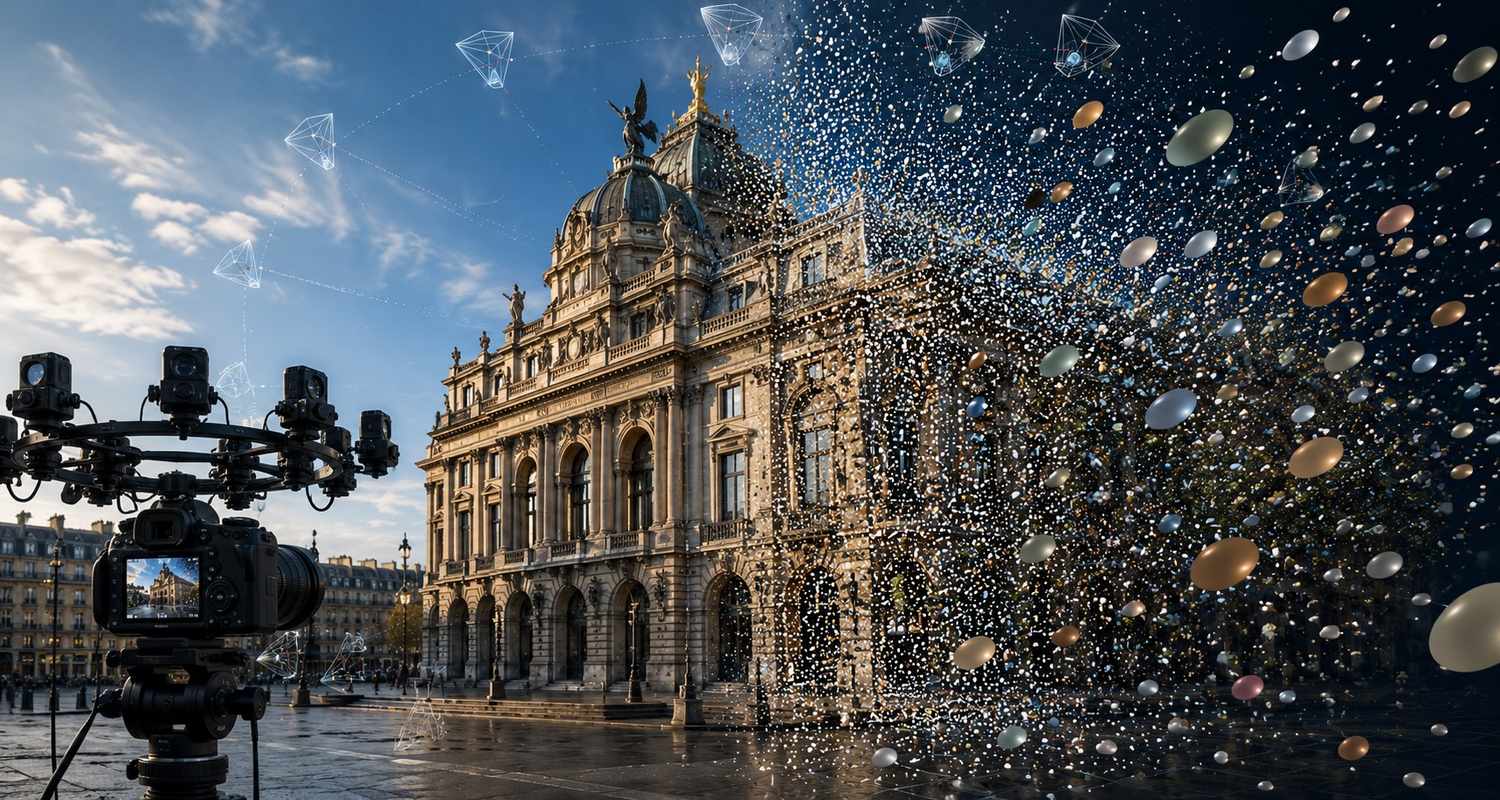
3D Gaussian Splatting (3DGS) is a cutting-edge real-time rendering technique that has fundamentally changed how we reconstruct and visualize 3D scenes from 2D images. Unlike traditional mesh or voxel-based methods, Gaussian Splatting represents scenes as millions of tiny, semi-transparent, ellipsoidal "splats" - each with its own position, orientation, color, and opacity. The result is strikingly photorealistic renders at interactive frame rates, making it one of the most exciting breakthroughs in computer graphics and spatial computing in recent years.
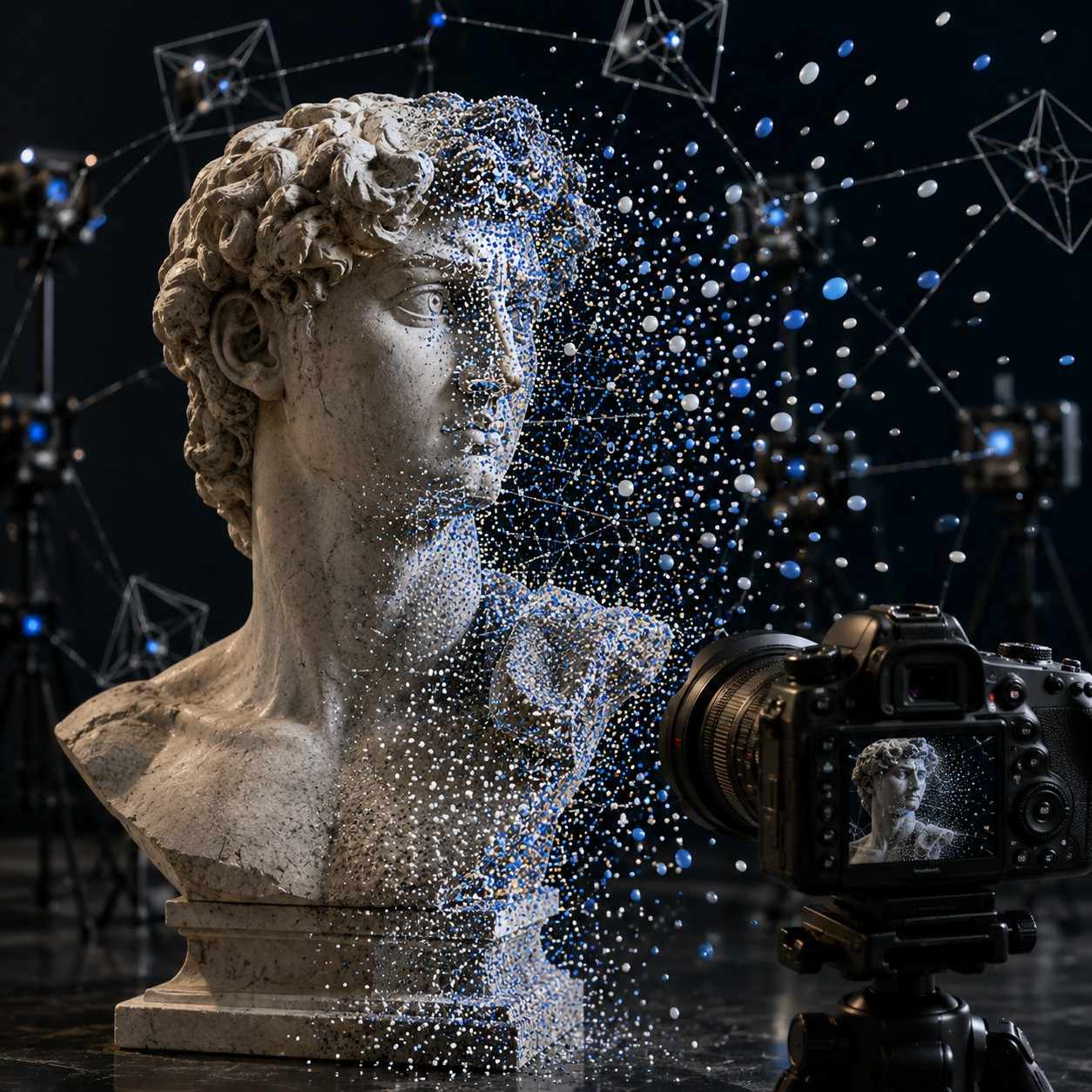
The pipeline begins with a set of 2D photographs of a scene or object taken from multiple angles. These images are processed through Structure-from-Motion (SfM) to generate a sparse 3D point cloud - essentially a rough skeleton of the scene. Each point is then initialized as a 3D Gaussian: a small, fuzzy ellipsoid defined by its center position, covariance matrix (controlling shape and orientation), spherical harmonics (encoding view-dependent color), and an opacity value.
An optimization process then refines these millions of Gaussians using gradient descent, minimizing the difference between the rendered views and the original photographs. Gaussians are adaptively added (densified) in areas that need more detail and removed (pruned) where they are unnecessary. The final model can be rendered from any viewpoint in real time by projecting and sorting these 3D splats onto the 2D screen - a process called splatting.
To truly appreciate Gaussian Splatting, one must look at the mathematical foundation. The technique relies on multivariate Gaussian distributions to represent the spatial occupancy and appearance of the scene. The covariance matrix, which must be positive semi-definite, is decomposed into a scaling matrix and a rotation matrix. This clever parameterization ensures that the optimization process remains stable while allowing each Gaussian to stretch and rotate to fit the underlying surface geometry perfectly.
Spherical Harmonics (SH) are used to represent view-dependent colors, which is crucial for reproducing complex lighting effects like specular highlights and reflections. Unlike flat colors, SH coefficients allow the color of a Gaussian to change depending on the viewing angle, mimicking how light behaves in the real world.
Neural Radiance Fields (NeRF) was the previous state-of-the-art for novel-view synthesis from photos. While NeRF produces stunning results, it suffers from extremely slow training times (hours to days) and slow rendering (seconds per frame), making it impractical for real-time applications. Gaussian Splatting addresses both of these limitations head-on.
The practical applications of Gaussian Splatting span across multiple industries, and adoption is accelerating rapidly as tools become more accessible.
One of the most exciting recent developments in Gaussian Splatting is its democratization through mobile applications. Until recently, creating high-quality 3D scans required specialized camera rigs or LIDAR scanners. Now, apps utilizing 3DGS allow users to generate photorealistic splats directly from a smartphone video.
By capturing a short video walking around an object or through a room, the app uses cloud processing to extract frames, run SfM, and optimize the Gaussians. Within minutes, the user receives an interactive 3D model that often captures reflections, transparencies, and fine details better than the LiDAR sensors built into modern phones.
Because Gaussians are explicit geometric elements (points in space with properties), they are inherently easier to edit than the implicit neural networks used in NeRFs. This has given rise to a new ecosystem of tools focused on editing splat scenes.
A major hurdle for web-based 3DGS is file size. A raw splat file for a room-scale scene can easily exceed a gigabyte. However, the introduction of advanced compression techniques has drastically reduced these sizes.
By quantizing attributes like color and position, and organizing Gaussians into spatial hierarchies (like octrees), developers have achieved 10x to 20x reductions in file size. This allows web browsers to stream Gaussian environments dynamically. Tools like WebGL and WebGPU have been rapidly updated to support native rasterization of these compressed splats directly in the browser, making instant-load web experiences a reality.
A major advantage of Gaussian Splatting over implicit neural representations is its compatibility with standard graphics pipelines. Since Gaussians are explicit geometric primitives, they can be manipulated, clipped, and combined with traditional polygonal meshes.
Plugins for industry-standard tools like Unity, Unreal Engine, and Blender have rapidly emerged. These integrations allow technical artists to import .ply files containing Gaussian data directly into their scenes, opening up hybrid rendering workflows where photorealistic splat-based environments serve as the backdrop for dynamic, traditional mesh-based characters and objects.
Since the original 3DGS paper from SIGGRAPH 2023, the research community has been moving at breakneck speed. Several key extensions have dramatically expanded what is possible.
While Gaussian Splatting is extremely fast to render, it is memory intensive. A typical scene might contain 2 to 5 million Gaussians, requiring significant VRAM. Training typically requires a robust GPU like an NVIDIA RTX 3090 or 4090 to achieve the fastest results. However, rendering can often be done on consumer-grade hardware, including high-end mobile devices and standalone VR headsets, provided the scene has been properly optimized and compressed.
Despite its remarkable capabilities, Gaussian Splatting still faces several open challenges that the research community is actively working to solve.
At NeuroFlares, we are at the forefront of exploring and integrating Gaussian Splatting into our AR/VR and spatial computing projects. We are actively researching how to leverage 3DGS for creating photorealistic digital twins, immersive product configurators, and next-generation training simulations for enterprise clients. The ability to go from a video walkthrough to a fully interactive 3D environment in under an hour is a game-changer for the solutions we build for our clients.
We believe Gaussian Splatting represents one of the most significant shifts in how digital worlds are built, and we are committed to harnessing this technology to deliver premium, photorealistic experiences across Apple Vision Pro, HoloLens, and web-based platforms.
Gaussian Splatting is not just an incremental improvement - it is a paradigm shift in 3D reconstruction and rendering. By combining the visual fidelity of NeRF with the real-time performance of rasterization, it opens the door to a new generation of immersive, photorealistic applications that were previously too slow or too expensive to be practical. As the tooling matures and hardware catches up, Gaussian Splatting is poised to become the foundational technology for how we capture, represent, and interact with the physical world in digital form.
Exploring this technology for your next project?
NeuroFlares specialises in building cutting-edge software solutions powered by the latest innovations. Let us turn your ideas into reality.
Let's work together.
2915 Ogletown Road, Newark, DE 19713, USA

213, G-Block, V.V.C.E, Gokulam, Mysore 570002, India
Connect with us
contact@neuroflares.com