





Connect with us
contact@neuroflares.com

June 28, 2026
Computer vision is rapidly becoming one of the most transformative technologies in modern manufacturing. By giving machines the ability to "see" and interpret visual information, manufacturers can automate quality control, predict equipment failures, optimize logistics, and dramatically reduce operational costs. From automotive assembly lines to pharmaceutical production, computer vision systems are reshaping the factory floor - and the companies that adopt them early are gaining a significant competitive edge.
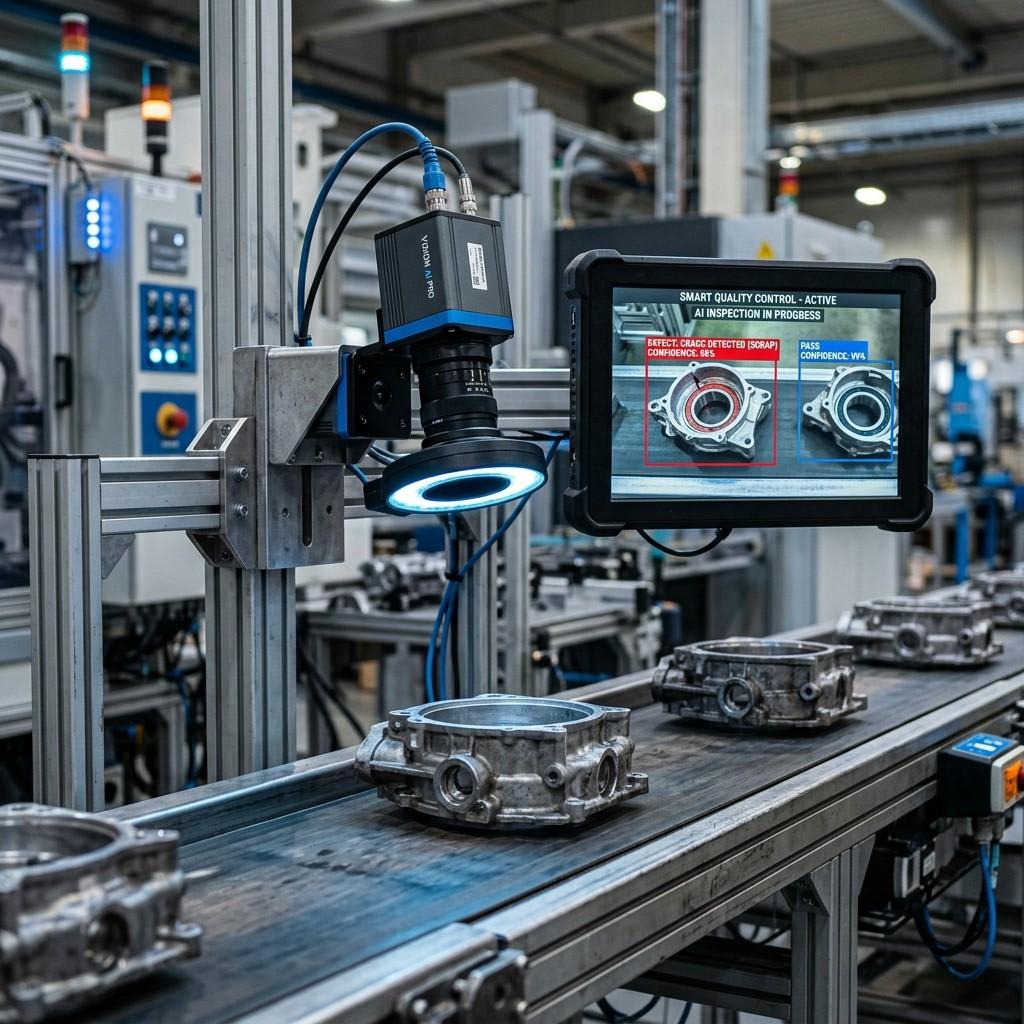
In manufacturing, computer vision refers to the use of cameras, image processing algorithms, and deep learning models to automatically inspect, classify, measure, and guide physical processes. These systems can detect defects invisible to the human eye, operate 24/7 without fatigue, and process thousands of items per minute with consistent accuracy. When combined with AI and edge computing, they become powerful real-time decision engines embedded directly into the production line.
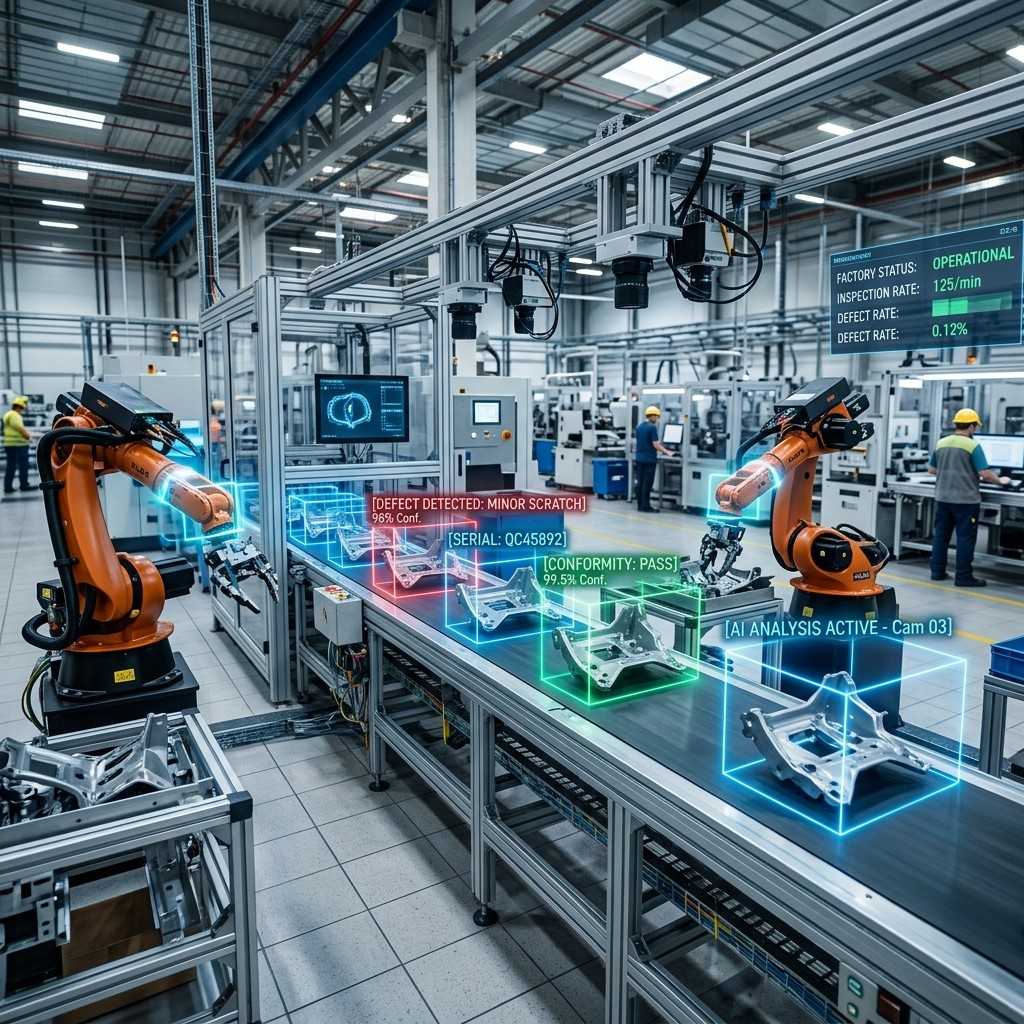
The most widely deployed application of computer vision in manufacturing is automated quality inspection. Traditional quality control relies on human inspectors sampling a small percentage of products - a process that is slow, inconsistent, and prone to fatigue-related errors. Computer vision enables 100% inspection of every unit on the production line at production speed.
Unplanned equipment downtime is one of the costliest problems in manufacturing, with industry estimates suggesting it costs manufacturers approximately $50 billion per year globally. Computer vision systems provide a non-intrusive way to continuously monitor equipment health by analyzing visual signals that precede failure.
Modern industrial robots are increasingly paired with computer vision to give them the flexibility to operate in unstructured environments. Traditional robots require precisely positioned parts in fixed fixtures - vision-guided robots can handle variability in part position, orientation, and even shape.
Vision-guided robotic systems use 2D and 3D cameras combined with deep learning to identify, locate, and grasp parts from bins, conveyors, or pallets in any orientation - a capability known as bin picking. This enables automation of previously manual tasks such as unloading delivery boxes, feeding components into assembly machines, or sorting mixed product types.
Manufacturing environments involve significant safety risks, including heavy machinery, moving vehicles, extreme temperatures, and hazardous materials. Computer vision is now being deployed to proactively identify and prevent safety incidents before they occur.
Beyond the production floor, computer vision is transforming warehouse and supply chain operations within manufacturing facilities. Vision systems automate tasks that previously required dedicated RFID infrastructure or manual scanning.
When defects are found late in the production cycle or worse, by the end customer, determining the root cause can be a massive challenge. Computer vision changes this dynamic entirely.
By capturing and archiving images of every single product at multiple stages of assembly, manufacturers can establish visual traceability. If a batch of products is returned due to a faulty weld, engineers can pull up the archived images of those specific serial numbers to see exactly how they looked during production. This allows rapid isolation of the root cause-whether it was a machine calibration issue or a raw material defect-saving immense amounts of diagnostic time.
While standard RGB cameras dominate the field, the application of multi-spectral and thermal imaging is expanding what is possible with computer vision.
Deploying computer vision in a factory is not without its hurdles. Real-world environments are messy, and algorithms that perform perfectly in the lab often struggle on the shop floor.
Generative AI is solving the "data scarcity" problem in manufacturing. Using technologies like Stable Diffusion or Generative Adversarial Networks (GANs), engineers can now generate photorealistic synthetic data. If a specific type of rare defect is missing from the dataset, generative AI can create thousands of varied examples to train the inspection model, drastically reducing the time it takes to deploy a robust vision system.
A critical enabler of modern manufacturing computer vision is edge AI - the deployment of AI inference directly on embedded hardware at the point of capture rather than sending data to a central cloud server. Manufacturing lines operate at high speeds where even a 100ms latency from a network round-trip could mean dozens of defective parts passing through inspection. Edge inference eliminates this latency entirely.
Platforms such as NVIDIA Jetson, Intel OpenVINO, and Qualcomm AI Hub enable high-throughput neural network inference directly on compact, ruggedized hardware installed within machines or camera housings. This means that even in facilities without reliable high-bandwidth internet, sophisticated AI inspection systems can operate reliably and in real time.
At NeuroFlares, we develop custom computer vision systems tailored to the specific quality standards, product types, and production speeds of our manufacturing clients. Our solutions leverage state-of-the-art deep learning architectures including YOLO for real-time detection, Segment Anything Model (SAM) for precise segmentation, and custom-trained anomaly detection networks built on datasets provided by our clients.
We deploy on edge hardware for zero-latency inspection, integrate with existing PLC and SCADA systems for seamless production line connectivity, and build intuitive dashboards that give quality engineers full visibility into defect trends, false positive rates, and system performance over time. Whether you need a turnkey inspection system or augmentation of existing processes, our team has the expertise to deliver measurable impact.
Computer vision is no longer a futuristic technology for manufacturing - it is a proven, deployable capability that is delivering measurable ROI for manufacturers worldwide. From eliminating defects before they reach customers to preventing catastrophic equipment failures and keeping workers safe, the applications are both broad and deeply impactful. As AI models continue to improve and edge hardware becomes cheaper and more powerful, the barriers to adoption will continue to fall. Manufacturers who invest in computer vision today are not just solving today's problems - they are building the intelligent factory infrastructure that will define their competitiveness for the next decade.
Exploring this technology for your next project?
NeuroFlares specialises in building cutting-edge software solutions powered by the latest innovations. Let us turn your ideas into reality.
Let's work together.
2915 Ogletown Road, Newark, DE 19713, USA

213, G-Block, V.V.C.E, Gokulam, Mysore 570002, India
Connect with us
contact@neuroflares.com