What if an AI could look at any application - a SaaS platform, a mobile app, or a complex enterprise tool - and reconstruct its entire architecture, data models, UI components, and business logic from scratch? That is the audacious promise of REA (Reverse Engineer Anything), a groundbreaking new AI system that is redefining the boundaries of software intelligence. In this article, we explore what REA is, how it works, what it means for the software industry, and why it matters to businesses and developers alike.
What is REA (Reverse Engineer Anything)?
REA is a next-generation AI system designed to analyze, understand, and replicate any software application. Unlike traditional code generation tools that start from a blank canvas, REA begins by deeply understanding an existing product-its user interface, user flows, APIs, data structures, and business logic - and then generates a fully functional, production-ready clone or derivative.
At its core, REA combines computer vision for UI analysis, large language model reasoning for business logic extraction, static and dynamic program analysis for backend reconstruction, and advanced code synthesis to produce clean, maintainable source code. The result is an AI that can ingest a running application and output a replication in hours rather than months.
How REA Works: The Technology Behind the Magic
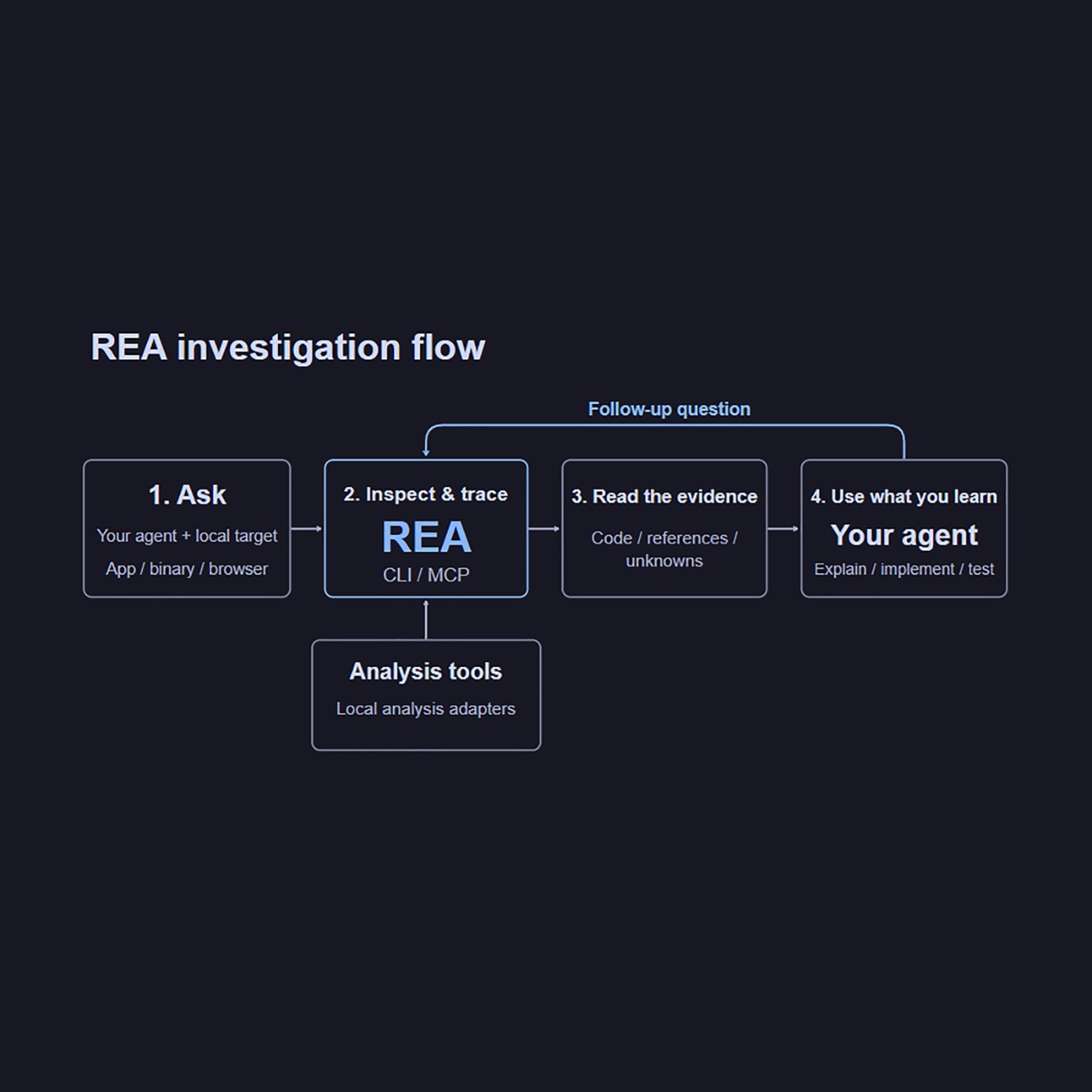
REA operates through a multi-stage pipeline that mirrors how an expert engineering team would approach reverse engineering, but executes it at machine speed and scale:
- Visual UI Parsing: REA uses computer vision models to analyze screenshots, screen recordings, and live app sessions, extracting layout hierarchies, component types, color systems, typography, and interaction patterns.
- API & Network Interception: By monitoring network traffic and intercepting API calls, REA maps out the full backend API contract- endpoints, request/response schemas, authentication flows, and data relationships.
- Business Logic Inference: Using LLM-powered reasoning, REA interprets the observed behaviors, forms, validation rules, and state transitions to infer the underlying business logic-even when the source code is inaccessible.
- Data Model Reconstruction: From observed API payloads and UI data bindings, REA generates entity-relationship diagrams, database schemas, and data access layer specifications.
- Code Synthesis & Generation: Finally, REA produces a clean, structured codebase-choosing appropriate frameworks, architecture patterns, and code style-that faithfully replicates the observed application's behavior.
Existing AI coding assistants like GitHub Copilot, Cursor, or Claude Sonnet are powerful at generating code from descriptions or completing existing code. However, they require a human developer to drive the process-specifying what to build, reviewing outputs, and iterating. REA takes a fundamentally different approach:
- Input is an App, not a Prompt: REA's input is a running application, not a text description. It observes and analyzes the target rather than depending on human specification.
- End-to-End Replication: REA produces a complete application-frontend, backend, database schema, and deployment configuration-not just isolated code snippets.
- No Source Code Required: REA works on compiled, closed-source, or cloud-hosted applications where the underlying source code is completely unavailable.
- Architecture-Level Understanding: REA reasons at the system architecture level, not just the file or function level, enabling it to reproduce complex multi-service and microservices architectures.
- Self-Verifying Output: REA runs automated tests against the original application and its generated replica to validate behavioral equivalence, iteratively refining until the outputs match.
Real-World Use Cases for REA
The ability to reverse engineer and replicate applications opens up a remarkable range of practical applications across industries:
- Legacy System Modernization: Organizations running decades-old applications on outdated stacks can use REA to produce a modern, cloud-native equivalent- drastically cutting the cost and risk of manual rewrites.
- Competitive Analysis & Benchmarking: Product teams can use REA to deeply understand competitor applications at a technical level, informing architecture decisions and feature roadmaps.
- Rapid MVP Creation: Entrepreneurs can use REA to replicate the best UX patterns and workflows from market leaders and use them as a foundation for their own differentiated product.
- Disaster Recovery & App Reconstruction: When source code is lost due to data loss, departed engineers, or acquisition gaps, REA can reconstruct a working application from the live product alone.
- Training Data Generation: AI teams can use REA to generate synthetic application code and data models at scale for training other AI models.
- Quality Assurance & Compliance: Security and compliance teams can use REA to generate a reference implementation and compare it against a production system to identify behavioral anomalies or unauthorized deviations.
The Ethical and Legal Landscape
As with any powerful technology, REA raises important ethical and legal questions that the industry must grapple with thoughtfully. The capability to replicate proprietary applications raises concerns around intellectual property, trade secrets, and software licensing.
REA's developers have implemented a set of responsible-use guardrails: explicit user intent verification, target application ownership validation, and built-in detection of proprietary asset fingerprints (logos, licensed fonts, patented algorithms) with automatic redaction. The system is designed to empower legitimate use cases- modernization, disaster recovery, competitive research-while resisting misuse as a tool for cloning commercial products without authorization.
Legal frameworks around reverse engineering vary significantly by jurisdiction. In many regions, reverse engineering for interoperability purposes is explicitly permitted under software copyright law (such as EU Directive 2009/24/EC). Regardless, organizations using REA are advised to ensure their specific use case falls within applicable legal boundaries and to engage legal counsel when uncertainty exists.
REA and the Future of Software Engineering
REA represents a profound shift in the software development paradigm. Historically, software has been an artifact of human intellectual effort-designed, written, and maintained by engineers. REA introduces a new dynamic where existing software itself becomes training data and raw material for producing new software.
This has far-reaching implications:
- Accelerated Innovation Cycles: When any existing application can be replicated and iterated upon in hours, the speed of software innovation accelerates exponentially.
- Democratization of Software Development: Startups and small teams without large engineering budgets can compete with established players by rapidly replicating and improving upon existing solutions.
- The Death of the Blank Canvas: The traditional software development lifecycle-requirements, design, build, test, deploy-is disrupted when an AI can short-circuit the first three stages.
- New Roles for Engineers: Rather than writing code from scratch, engineers will increasingly focus on high-level architecture decisions, domain expertise injection, and ethical review of AI-generated systems.
- Application as Interface: As REA matures, the distinction between using an application and owning its source code begins to blur-any application you can use, you can also replicate.
How NeuroFlares is Leveraging REA for Client Engagements
At NeuroFlares, we are actively integrating REA into our service delivery model to provide clients with unprecedented speed and quality in application development and modernization. Our team has developed a structured engagement framework built around REA's capabilities:
- Legacy App Modernization Sprint: We use REA to rapidly reconstruct client legacy applications as a foundation, then apply modern architecture patterns, cloud-native infrastructure, and updated UX-cutting modernization timelines by 60-80%.
- Competitive Benchmarking Analysis: For product strategy clients, we deploy REA to produce technical analyses of competitor applications, helping clients understand architectural strengths and weaknesses to inform their own product roadmap.
- Rapid Prototype Generation: For new product development, we use REA to extract the best-in-class UX patterns from market-leading apps and use them as a starting point for our clients' differentiated products.
- Application Reconstruction: When clients have lost access to source code due to vendor lock-in or data loss, we deploy REA to reconstruct a working application from the production environment.
The results have been transformative. Projects that previously took six to twelve months are now reaching their first working prototype in four to eight weeks. The engineering effort shifts from low-level coding to high-level design, customization, and optimization-exactly where human expertise delivers the most value.
Technical Limitations and Current Constraints
Like all frontier AI systems, REA is not without its limitations. Understanding these constraints is essential for setting realistic expectations and designing engagements appropriately:
- Closed AI/ML Models: REA can replicate application behavior, but it cannot reconstruct proprietary machine learning models embedded within an application. These require separate training efforts.
- Deeply Encrypted or Obfuscated Logic: Applications with heavy code obfuscation or runtime encryption present challenges for behavioral inference, particularly for complex offline-first applications.
- Hardware-Dependent Features: Applications deeply integrated with proprietary hardware sensors or custom silicon capabilities cannot be fully replicated at the software layer alone.
- Complex State Management: Applications with extremely complex distributed state management (e.g., multi-region transactional systems) may require significant human engineering effort to complete after REA's initial reconstruction.
- Dynamic & Personalized Content: Applications heavily driven by personalized AI recommendations or real-time dynamic content require additional work to replicate the content generation layer.
Getting Started with REA
Organizations interested in leveraging REA for their software projects should approach adoption through a phased strategy:
- Define the Target Application: Clearly identify the application to be reverse-engineered, its scope, and the specific components that require replication.
- Legal & IP Review: Conduct a legal review to confirm the intended use case falls within applicable laws and organizational policies.
- REA Analysis Phase: Run REA's analysis pipeline against the target application to generate architecture diagrams, API contracts, data models, and initial codebase.
- Human Engineering Review: Your engineering team reviews and validates REA's outputs, identifies gaps, and refines the generated codebase.
- Customization & Differentiation: Build the features, optimizations, and differentiating functionality that transform the replica into your own product.
- Testing & Validation: Comprehensive QA comparing the REA-generated system against the target to validate behavioral equivalence or intentional improvements.
Conclusion: REA and the Age of Software Intelligence
REA is more than a tool-it is a signal that we are entering a new era in software development, where AI systems can not only generate code but understand, analyze, and replicate entire applications. For businesses, this means dramatically lower barriers to building sophisticated software. For engineers, it means the evolution of the craft toward higher-order design and problem-solving. For the industry as a whole, it raises profound questions about what it means to build software in a world where any application can be understood and reproduced by an AI.
At NeuroFlares, we are on the frontier of this transformation. Whether you are looking to modernize a legacy system, accelerate product development, or explore what AI-powered engineering can do for your organization, we are here to help you harness the power of tools like REA responsibly and effectively.
Exploring this technology for your next project?
NeuroFlares specialises in building cutting-edge software solutions powered by the latest innovations. Let us turn your ideas into reality.
Let's work together.